

Welcome to the first edition of the blog for Northeast Washington Trends! The blog captures the most recent updates to the indicators on the Northeast Washington Trends website, and will be sent out on a quarterly basis. Northeast Washington Trends would like to thank the Tri-county Economic Development District, Providence Medical, and other contributors for their support of the project.
Recent Updates
In PEOPLE: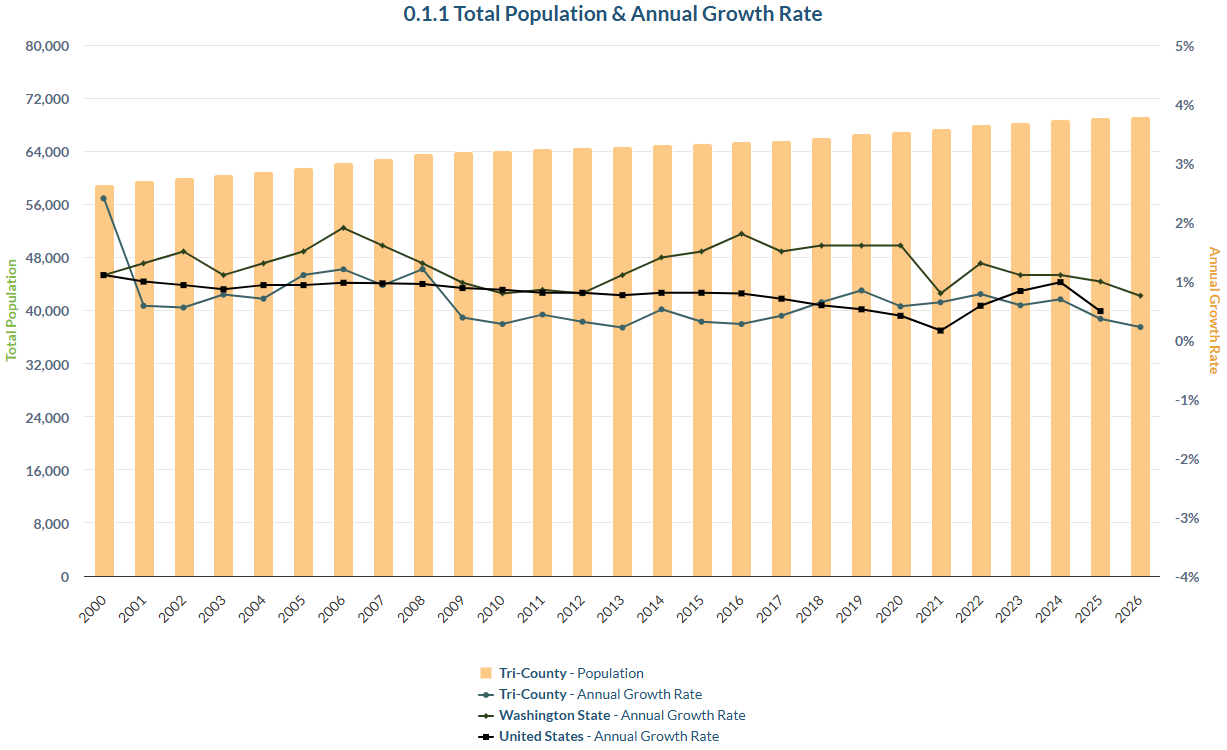
Population growth in the three counties continues to slow.
In the year between April 1 of 2025 and 2026, the three counties added very little to their population numbers. The state of Washington’s Office of Financial Management estimates that a total of 150 new residents found their way to this part of the state. That growth is reflected by an annual rate of 0.2%, the slowest since 2013.
Pend Oreille County was the fastest growing of the three counties, Ferry the slowest. The slowing population growth is not unique to northeast Washington, as the state grew by 0.8%, year over year. This represents the slowest since pandemic year 2021.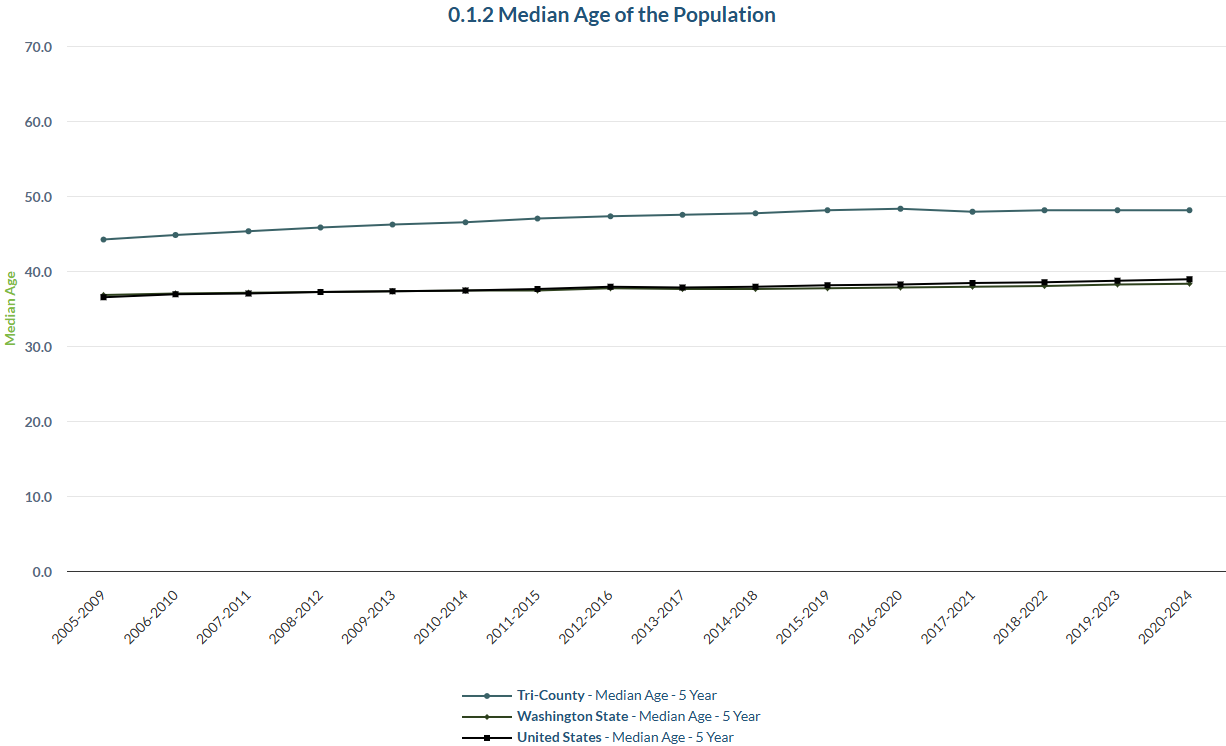
Population by age groups shows further aging in all three counties.
There are two distinguishing features of the population of the three counties by age. First, the share of the 65+ population is much higher than in the state. In the interval 2020-2024, 30% of the total population fell into this category, versus 18% for Washington. Due to the small population size of northeast Washington counties, Census provides estimates in five-year intervals. A decade ago, its share was 23%. In contrast, young adults (18-34 years) claimed about 16% of the population, versus 23% for Washington. It hasn’t moved as much; a decade ago, the share was 17%.
Ferry County currently claims the largest share of the 65+ population and the smallest share of the 18-34 years group among the three counties.
To simplify the graph, click off the item in the legend you would like to hide
In ECONOMIC VITALITY: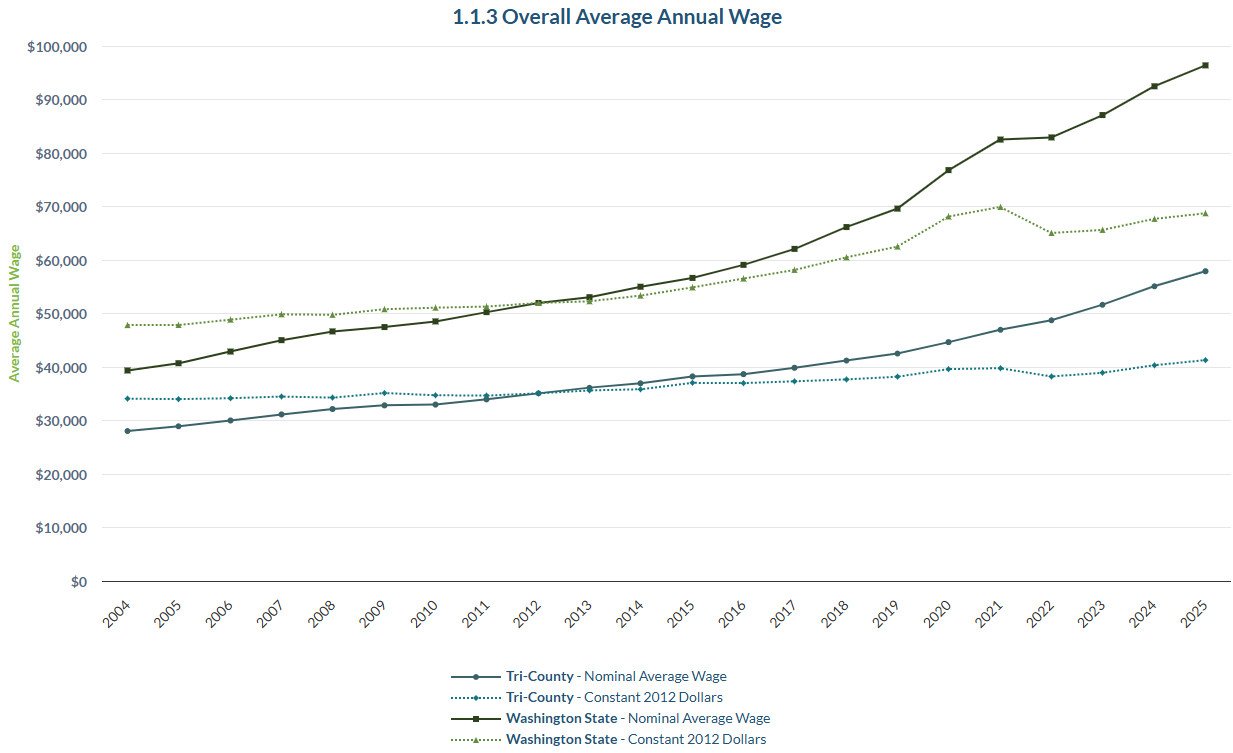
The area’s overall annual wage climbed nicely in 2025.
Average earnings, or wage, reflect(s) a variety of factors: the number of hours worked in a year, the mix of industries as some pay much more than others, supply and demand in the labor force, the minimum wage, and in some instances, the presence of collective bargaining. Earnings from work typically comprise the largest component of personal income, a core measure of community well-being.
This indicator reflects average wage and salary earnings by employees of organizations in the three counties who pay into the Unemployment Insurance fund. Sole proprietors are generally not counted.
The average annual wage over the three counties in 2025 was about $57,900. This represented a gain of approximately $1,800 over 2024, or a percentage increase of 5.1 %. This bested the average state gain of 4.2%. Of the three counties, employees of Pend Oreille businesses, government and non-profits experienced the largest jump (6.4%) while those in the two other counties registered a 4.6% increase.
On this basis, personal income data for 2025 may look favorable, when released this fall.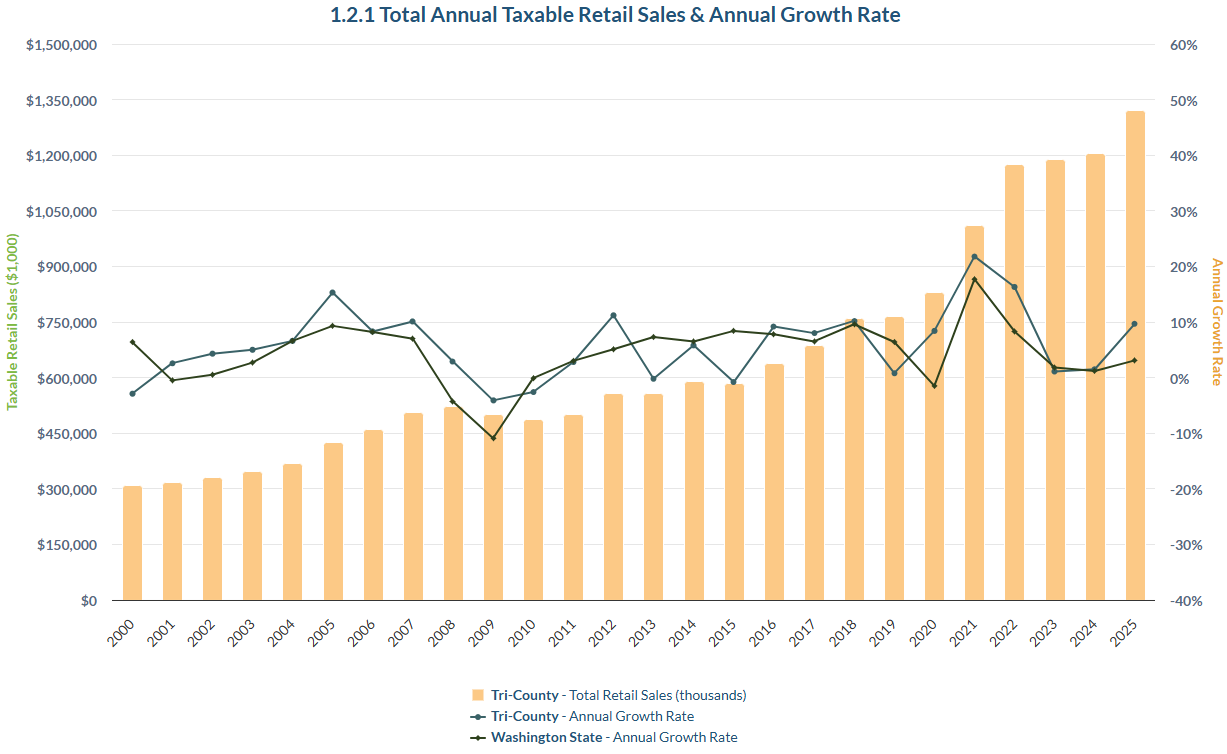 Tri-county annual taxable retail sales climbed in 2025, but just barely.
In Washington state, taxable retail sales are crucial to the budgets of both state and local governments. They also reflect the strength of the current buying power of local consumers. (Plus, the pulse of the construction sector, since it’s taxed this way, too.) Of course, tourists may add “new dollars” to an economy, augmenting but likely not distorting, the local effect in northeast Washington.
In 2025, annual taxable retail sales combined for the three counties hit a record, but just barely. They totaled $1.2 billion, but that represented a mere $17 million over 2024 results. The year-over year growth rate was low for the second straight year, at 1.5%. This tied the rate of growth in the state, nonetheless. For several years in the last decade, taxable retail sales in the three counties combined grew at a faster clip than those in the state. 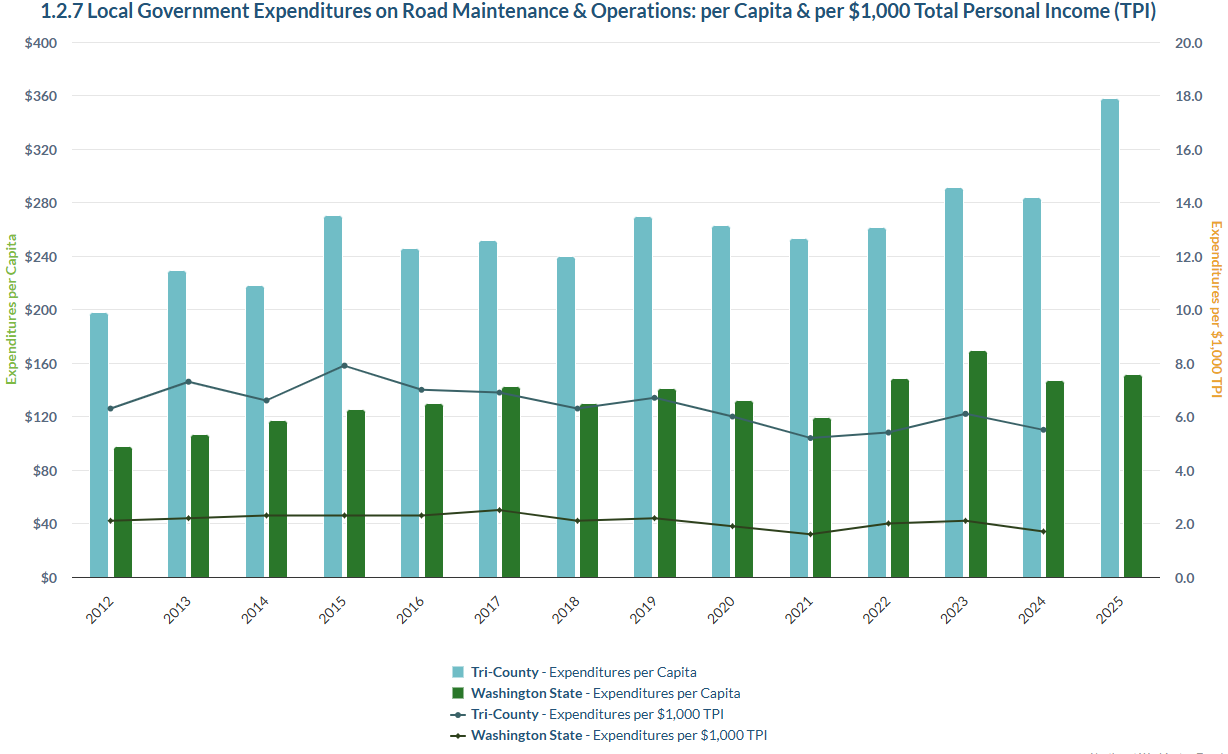
Local government expenditures on road maintenance & operations surged in 2025 in northeast Washington.
Job creation is a goal of all economic development efforts. This indicator considers the net effect: gains after job losses are factored in. This measure, unlike the immediately preceding one, covers the payroll of employers in the three counties and not necessarily residents. In other words, some of the jobs can be taken by non-residents who commute to local employers.
Some job creation took place in 2024 versus 2023, but at a more muted pace than in the preceding years. Area employers added a total of 142 jobs. The area’s annual growth rate was about equal to that of the state. All three counties posted increases in this measure, although Stevens County dominated the gains.
In EDUCATION: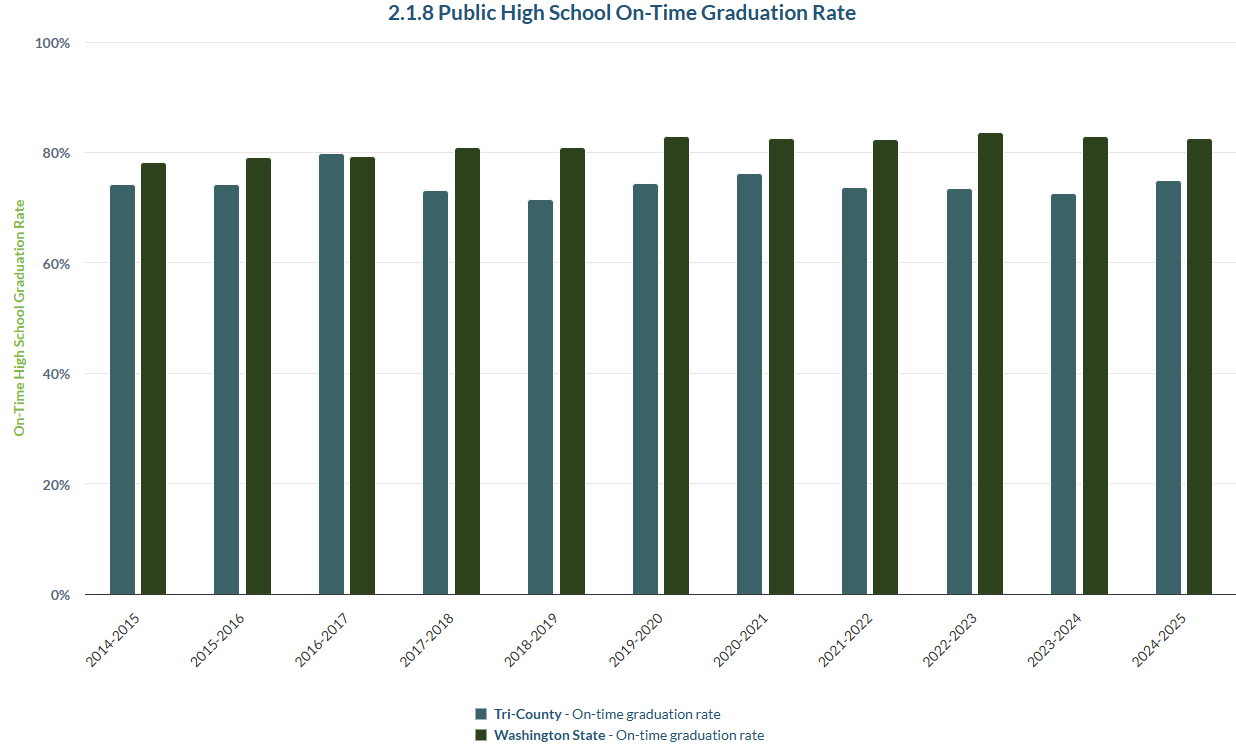
Public high school graduation rates rose slightly in school year 2024-2025 in northeast Washington.
Collecting a high school diploma is a rite of passage for most teenagers. More than a symbol, the ceremony signals that this student has attained an important educational milestone, one that, many hope, leads to at least some post-secondary education or training. The rate also is part of the report card of a school district, reflecting its success in preparing all students to hit this milestone.
The on-time, or 4-year, graduation rate measures the share of a 9th grade cohort that receives a diploma four years later. The cohort (denominator) is adjusted by transfers in and out of a district.
For school year 2024-25, the average on time graduation rate among all districts in the three counties was 75%. This is very close to the average over the prior decade of 74%. The state on-time rate has typically been several percentage points higher. Last year, it was nearly 83%. There is also substantial variation among the three counties, with Pend Oreille County schools the highest and Ferry County schools the lowest.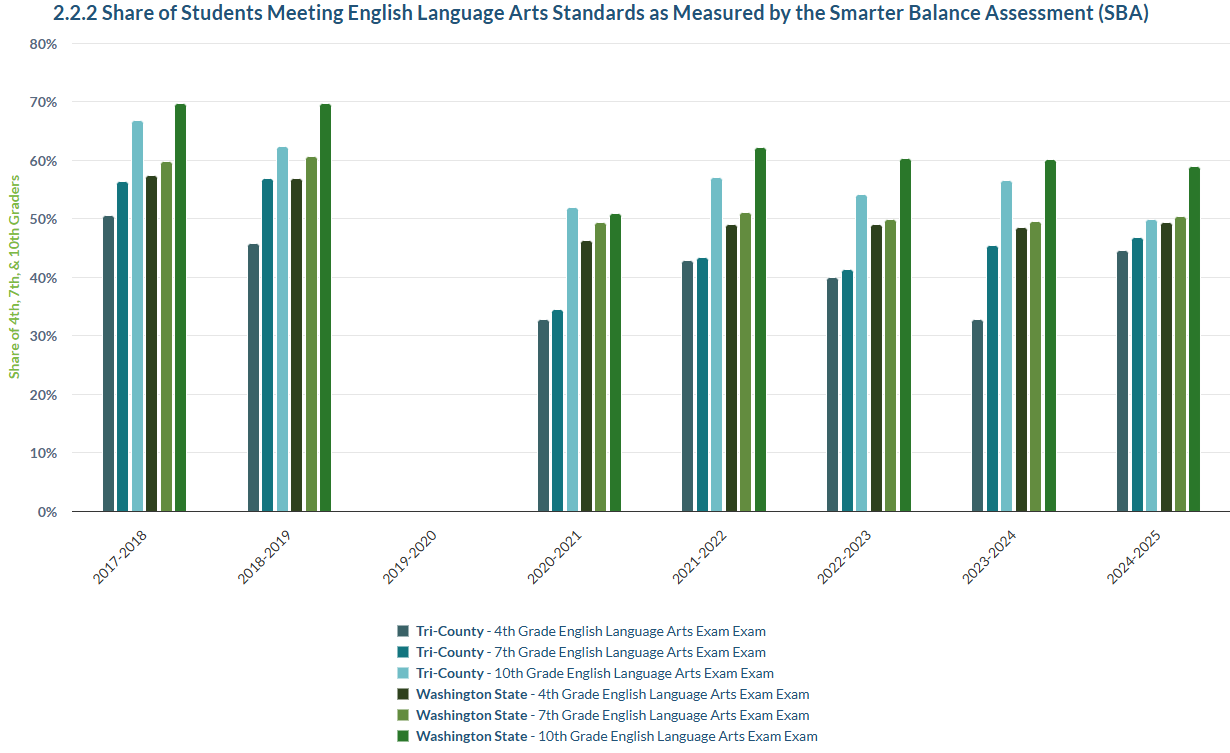
Since 2014, Washington state public school students must take two parts of the Smarter Balanced Assessment: English Language Arts and Mathematics. Now, some grades must also take a Science assessment. The results are scored in four quartiles, with the top two representing “meeting standard.” This indicator tracks the share of students in 4th, 7th and 10th grades whose results “meet standard” on the English Language Arts assessment.
Average results from the 2024-25 school year for all the districts in the three counties, by grade level, were: 45%, 47% and 50%, respectively, meeting standards. For grades 7 and 10, these results are well below the pre-pandemic share of school year 2018-2019. The pandemic slump is not unique to the three counties, however. The graph reveals a similar decline for the average statewide rates.
In all years, the three county average rates have rested below the state rates.
To simplify the graph, click off the item in the legend you would like to hide
In HEALTH: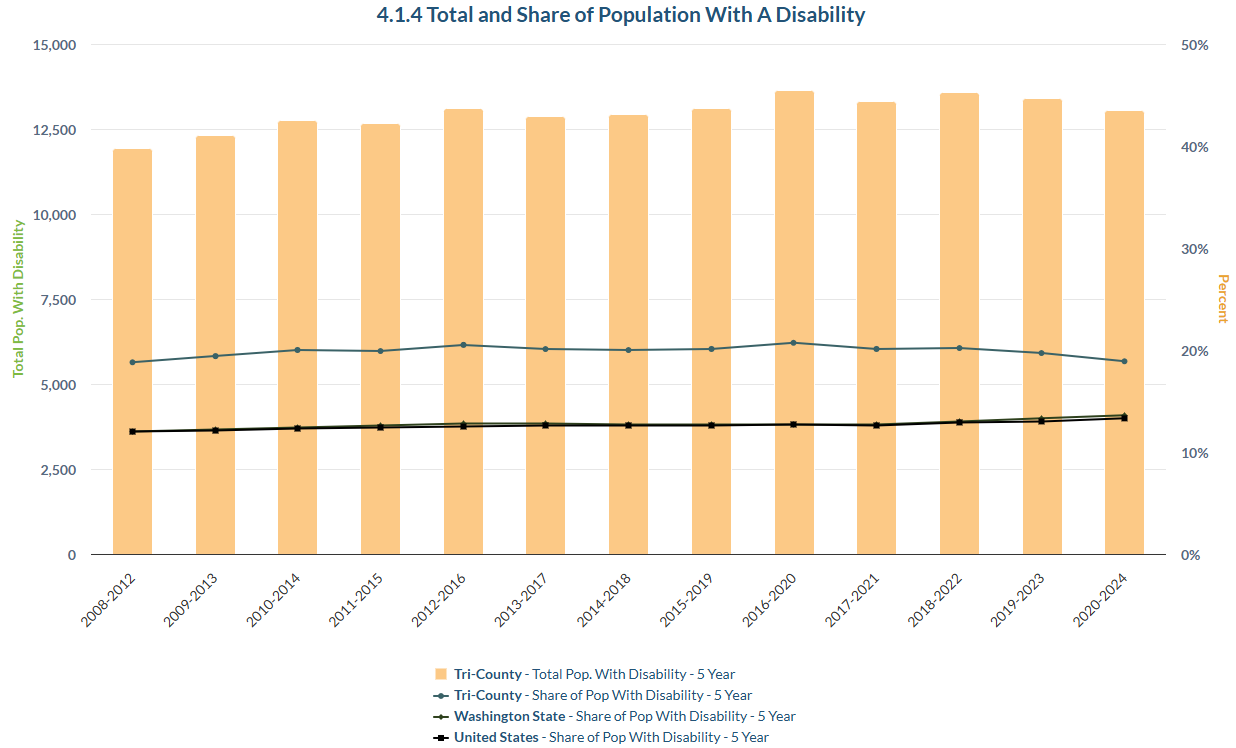
Persons with a disability continued a recent, slight decline in the three counties.
People may suffer a disability for physical or mental reasons. In many cases, the condition will prevent them from holding a job. In certain cases, especially for the disabled elderly, the condition will demand the presence of caregivers. Census estimates of the disabled population put them in six categories: hearing, vision, cognitive difficulty, ambulatory difficulty, self-care difficulty, independent living difficulty. They are not mutually exclusive conditions. Ambulatory difficulty is typically the largest category.
This measure tracks both the total and population share of the number of residents with a specific disability. In the 2020-2024 period, the estimate stood at a bit more than 13,000. If every respondent had just one disability, that translates into a rate of 19%, or nearly one out of every five. However, as mentioned, some have two or more, lowering the likely share.
This share has been much the same over the past decade. It is, furthermore, considerably higher than the state and national averages. Undoubtedly the local results reflect a population that is much older than the state or U.S.
In HOUSING: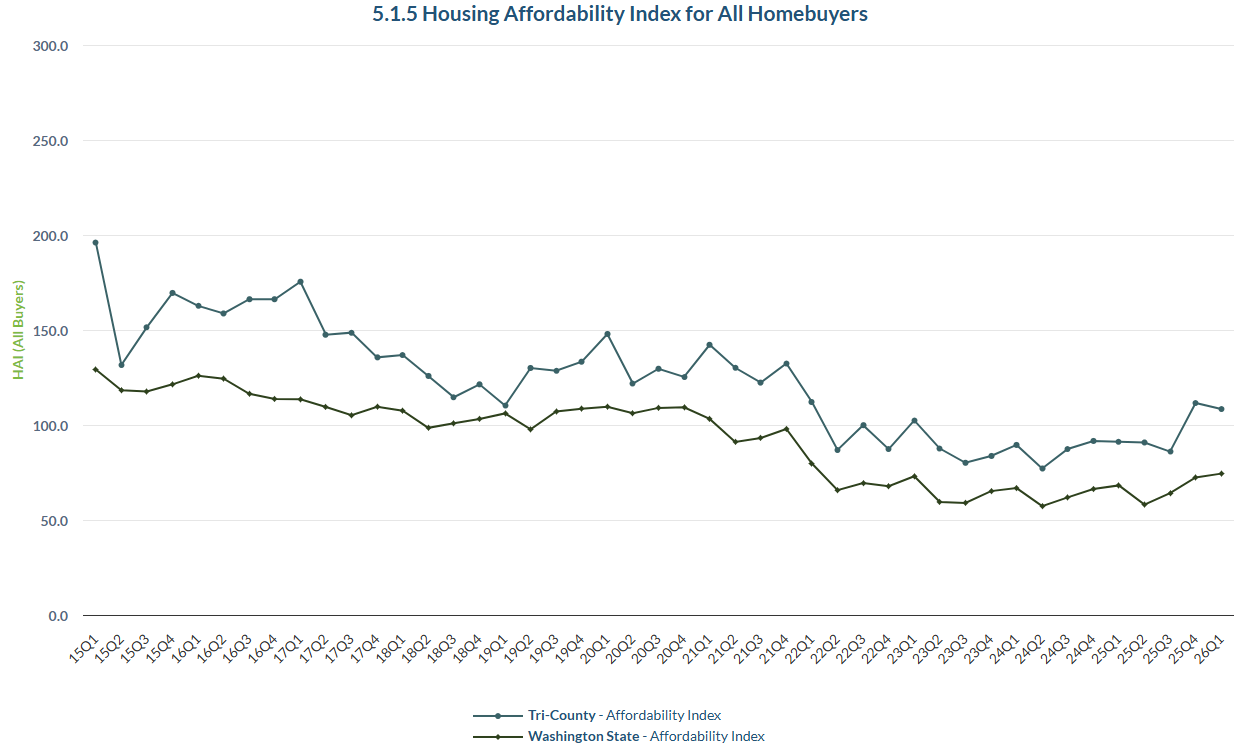
All-buyer Housing Affordability Index returns to affordable in the three counties.
Housing prices are an important measure of the housing market. But they don’t tell the entire story. Incomes matter, too. As incomes rise, housing should become more affordable. That is, unless housing prices rise faster. Essentially, a housing affordability index is ratio of income to mortgage costs. In this version of the index, it is median household income divided by current mortgage costs, assuming a 30-year loan and 20% down for a median priced home.
If the index reads 100, it implies that the median household (all-buyer) has just enough income to afford the median priced home under current market conditions. If the index is less than 100, the household pays more than 30% and is consequently in the “unaffordable” category. If the index lies above 100, it means a household at the income median faces mortgage costs that imply paying less than 30% of its income for housing.
In the first quarter of 2026, the average affordability index value for the three counties was greater than 100. specifically at 108. Pre-pandemic, housing by this measure in the three counties was always affordable but declined dramatically after 2022 to become unaffordable. Ferry County has shown the biggest recent gains in all-buyer housing affordability.
In RECREATION & TOURISM: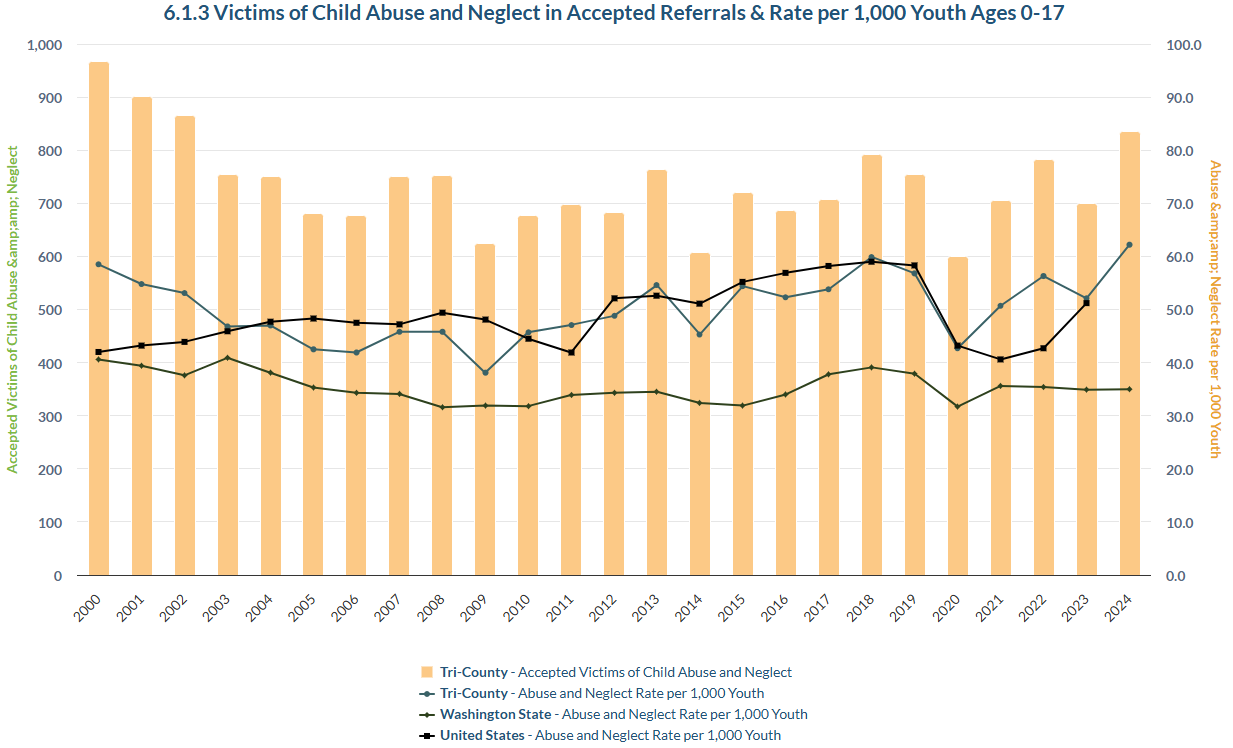
The number of cases of child abuse & neglect is moving in the wrong direction in the three counties.
Adults treating other adults badly, including criminally, is upsetting to experience and witness. Adults treating children badly elicits revulsion and condemnation. This measure captures the number of accepted referrals to Child Protective Services in each county and in the three-county aggregate. Since small children cannot or won’t speak for themselves, the annual total is very likely an undercount.
For the three counties combined, 2024 brought the highest number of referrals since 2002. The number stood at 835. This translates into a share of the local youth (0-17 years) population of 62 per 1,000. This represents the highest rate on record. It is much higher than the current Washington state average of 35 per 1,000 youth in 2024. Generally, rates in the three counties have been elevated for decades.
For 2024, Stevens County registered the lowest rate, Pend Oreille County, the highest.
list updated 08.6.26